Etuk’s ISADOK earns academic praise
A theatrical production directed by a student of the Department of Theatre and Film Studies at the University of Uyo (UNIUYO) has set a new assessment standard in directing concept, according to Professor Imo Emenyi of the university’s Department of English.
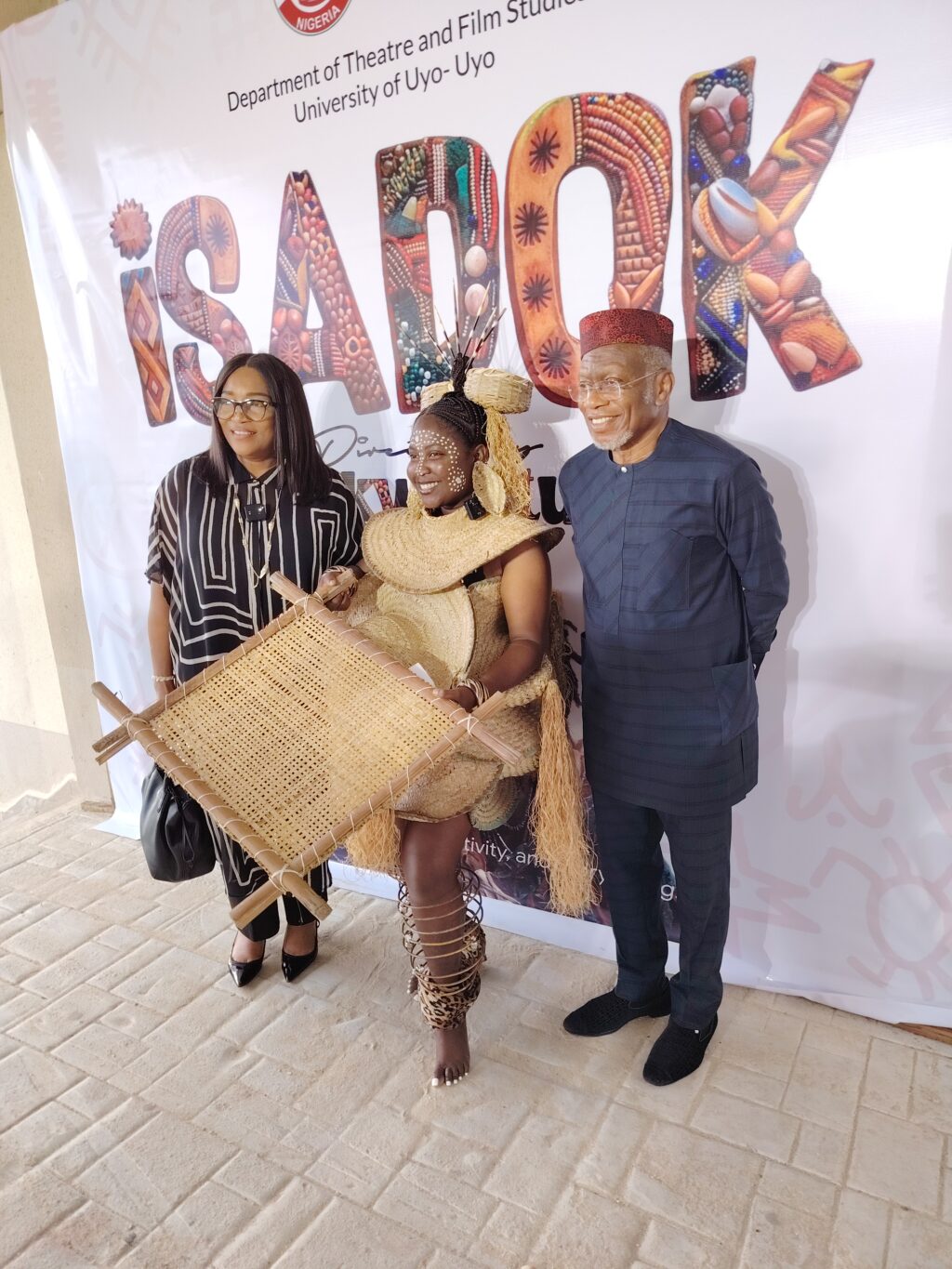
Emenyi asserted while serving as external examiner during the staging of Professor Uwemedimo Atakpo’s play, ISADOK, presented as part of the requirements for the award of a doctorate in Theatre and Film Studies to Mr Asukwo Etuk.
Etim Ekpimah
A theatrical production directed by a student of the Department of Theatre and Film Studies at the University of Uyo (UNIUYO) has set a new assessment standard in directing concept, according to Professor Imo Emenyi of the university’s Department of English.
Emenyi asserted while serving as external examiner during the staging of Professor Uwemedimo Atakpo’s play, ISADOK, presented as part of the requirements for the award of a doctorate in Theatre and Film Studies to Mr Asukwo Etuk.
The play, written by Professor Atakpo and directed by Etuk, explores the harmonisation of Western and traditional cultural values, while emphasising the supremacy of God over overwhelming traditional forces in society.
Speaking at the event, held at the Department of Theatre and Film Studies, University of Uyo main campus, Nwaniba Road, Uyo, Emenyi commended the director’s interpretation of the playwright’s thematic preoccupation and his conceptualisation of Ibibio cosmology.
A specialist in dramatic literature, she said Etuk successfully gave meaning to the Ibibio worldview by clearly portraying the relationship among the living, the dead and the unborn.
She noted that although Etuk remained faithful to the script as both director and critic, he could have introduced more personal innovations, including reducing the production’s duration from its 102-minute runtime.
Emenyi described the performance as intellectually engaging in concept, style and worldview interpretation, adding that the scenes effectively enhanced understanding of the environment, despite her not having previously read the script.
She praised the production’s dialogue direction, characterisation, make-up, costume design, set arrangement and musical composition.
However, she identified shortcomings in articulation, voice projection, pronunciation, lighting visibility, floor pattern and the handling of props on set.
ISADOK serves as a metaphorical exploration of cosmological puzzles within Ibibio society, reflecting the people’s belief system and aligning with Wole Soyinka’s concept of the existence of three worlds — the living, the dead and the unborn.
The play examines the overwhelming influence of Atakpo and Amamong, ancestral deities and belief systems of the Uruan and Okobo people of Akwa Ibom State.

Set in a desolate rural homestead, the production vividly portrays neglect through a cracked mud wall and cobweb-filled surroundings.
In its opening scene, Mama Koko sits rocking on a wooden stool, cradling a covered baby, while sorrowful songs and the sound of the talking drum heighten the atmosphere of despair.
The narrative follows how the oppressive forces of Atakpo and Amamong, alongside the pursuit of city life, separate Itabi and Mama Koko. While Mama Koko remains trapped in the village under the grip of Atakpo’s priest, Itabi seeks change in the city but remains haunted by ancestral forces.
As tradition clashes with the rise of Christianity, the play presents divine intervention as the ultimate path to deliverance from ancestral bondage. Through faith, the overwhelming grip of Atakpo and Amamong is broken, leading to the family’s redemption and reunion.
As a theatre-for-development production, ISADOK employs indigenous aesthetics to interrogate the cultural nuances of the Uruan people, using Itabi’s personal journey as a reflection of broader societal tensions.