Bayelsa faces severe oil pollution, says Bassey
Environmental activist and Director of the Health of Mother Earth Foundation, Dr Nnimmo Bassey, has described Bayelsa State as one of Nigeria’s most severely polluted areas because of decades of oil exploration and production.
Bassey made the assessment on Thursday during a one-day capacity-sharing programme with residents of Nembe at the Nembe City Hall, King Koko Square, in Nembe Local Government Area.
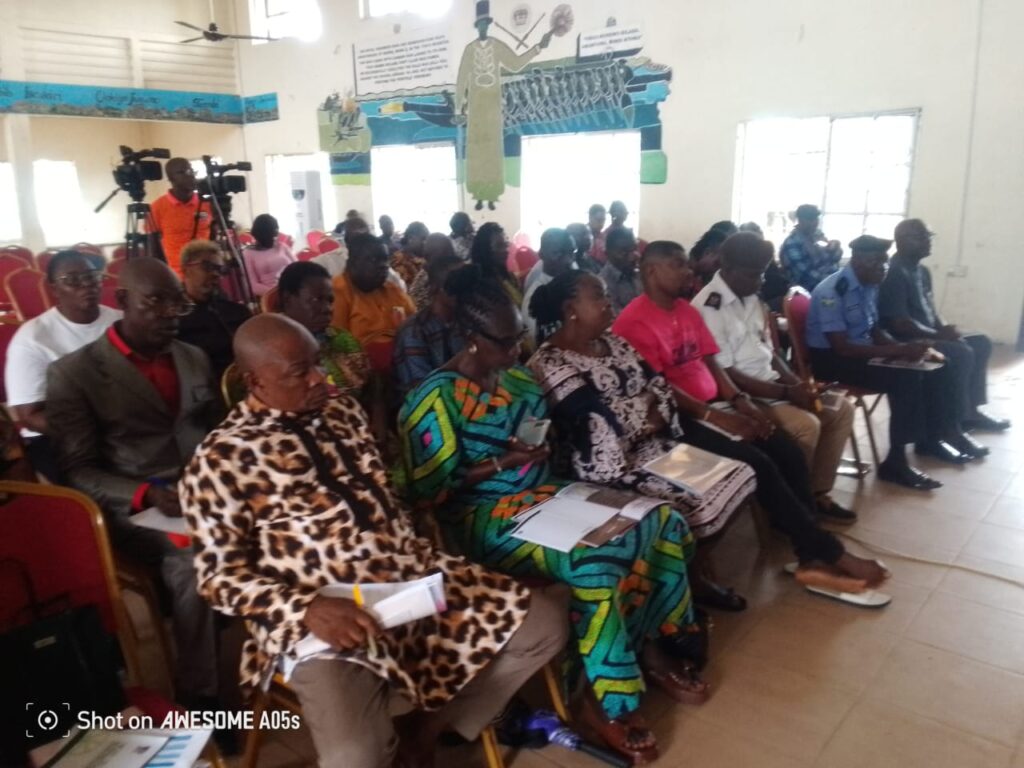
*Participants at the capacity-sharing programme in Nembe
Nathan Tamarapreye, Yenagoa
Environmental activist and Director of the Health of Mother Earth Foundation, Dr Nnimmo Bassey, has described Bayelsa State as one of Nigeria’s most severely polluted areas because of decades of oil exploration and production.
Bassey made the assessment on Thursday during a one-day capacity-sharing programme with residents of Nembe at the Nembe City Hall, King Koko Square, in Nembe Local Government Area.
He said data from the Bayelsa State Oil and Environment Commission indicated that the state had experienced significant hydrocarbon pollution, with the commission’s report, published in May 2023, recording an estimated per-capita oil pollution equivalent of 1.5 barrels of crude oil.
Bassey said the scale of environmental degradation in the Niger Delta required urgent and sustained remediation, warning against treating the region as a sacrifice zone for oil production.
He also cited the United Nations Environment Programme’s environmental assessment of Ogoniland, Rivers State, as evidence of the extensive environmental consequences of oil pollution in the Niger Delta.
According to him, the assessment, commissioned by the Federal Government and conducted between 2009 and 2011, involved scientific fieldwork, laboratory analysis and consultations with communities across the four Ogoni local government areas of Khana, Gokana, Tai and Eleme.
Bassey criticised what he described as inadequate efforts by oil companies to clean up polluted sites, saying environmental remediation must go beyond superficial interventions and address the underlying damage to land, water and livelihoods.
He called on oil companies and relevant authorities to end practices that contribute to the degradation of the Niger Delta, noting that the region had endured the consequences of oil extraction since the 1950s.
Bassey, a recipient of the national honour of Member of the Order of the Federal Republic, also raised concerns over the combined effects of oil and gas extraction, deforestation and erosion on the Niger Delta’s land and coastlines.
He said the description of the region’s environmental condition as “environmental genocide” was weighty but reflected the seriousness of the crisis and should not be dismissed.
The Head of Administration, Nembe Local Government Area, Mr Godson Jim-Dorgu, said oil spills and other impacts of petroleum operations had historically affected communities in Nembe.
Jim-Dorgu said pollution had damaged fishing and farming activities, worsening economic hardship among residents, and called on the Federal Government and oil companies to commence meaningful remediation of affected areas.
He cited the Santa Barbara oil spill, which he said lasted for about six weeks in 2023, as an example of the environmental challenges confronting the area. According to him, the affected environment had yet to receive adequate clean-up, with consequences for aquatic life.
The Director of Primary Health Care, Nembe LGA, Chief Jude Pulemote, said oil exploration and production had also created health and livelihood challenges for rural communities.
Pulemote urged the Federal and Bayelsa State governments to take stronger action to address the environmental and socio-economic consequences of oil activities in Nembe and other affected communities in the Niger Delta.