Eket symposium pushes resource economy development
Despite possessing vast deposits of clay, kaolin, limestone, silica sand and granite, alongside a 129-kilometre coastline with enormous maritime opportunities, the district has for decades struggled to translate its natural wealth into sustainable economic development.
That challenge formed the focus of a high-level symposium organised by the Association of Eket Senatorial District Media Professionals in collaboration with the Solid Minerals Development Fund (SMDF) and the Nigerian Maritime Administration and Safety Agency (NIMASA).
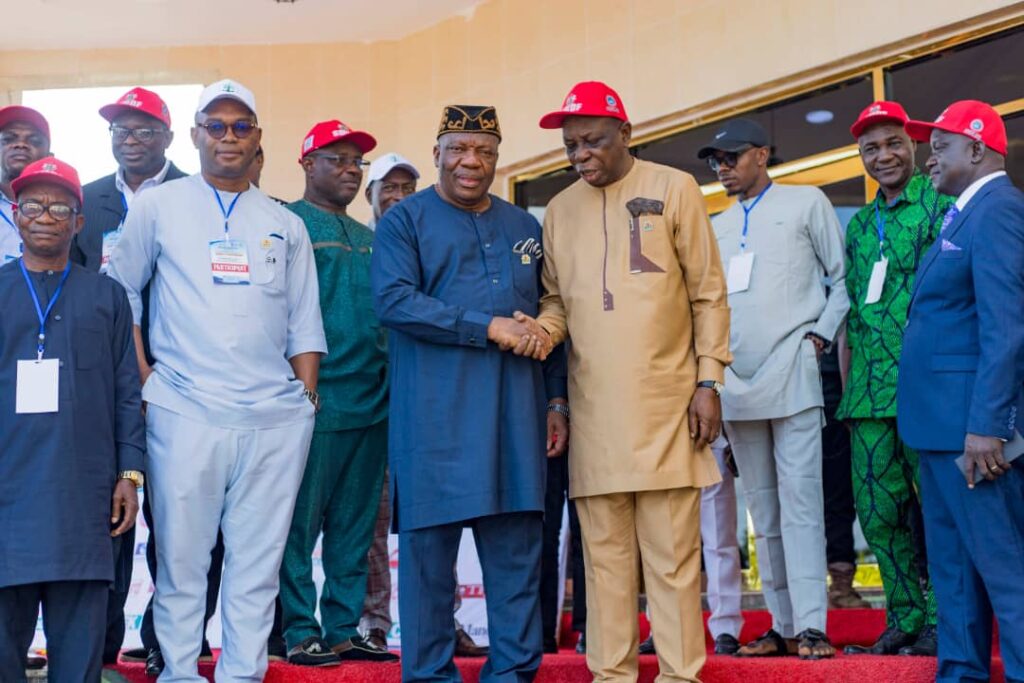
Middle: Senator Ekong Sampson with Sport Commissioner, Paul Bassey, exchanging pleasantries while others watch.
Etim Ekpimah
Akwa Ibom South Senatorial District may be on the verge of redefining its economic future as stakeholders intensify calls for strategic investment in solid minerals and the blue economy to unlock the region’s untapped potential.
Despite possessing vast deposits of clay, kaolin, limestone, silica sand and granite, alongside a 129-kilometre coastline with enormous maritime opportunities, the district has for decades struggled to translate its natural wealth into sustainable economic development.
That challenge formed the focus of a high-level symposium organised by the Association of Eket Senatorial District Media Professionals in collaboration with the Solid Minerals Development Fund (SMDF) and the Nigerian Maritime Administration and Safety Agency (NIMASA).
Held at Nissi Hall, Eden Hotels Limited, Eket, on May 20, 2026, the symposium brought together journalists, policymakers, scholars, traditional rulers and civil society organisations to explore the role of the media in advancing responsible resource management and economic growth.
Themed “Harnessing Akwa Ibom South’s Natural Resources: The Role of Media Professionals,” the event also served as the third capacity-building programme facilitated by Senator Ekong Sampson for media professionals within the district.
Participants stressed that effective reporting and sustained public engagement would be critical in driving investment, accountability and policy reforms in the solid minerals and maritime sectors.
Chairman of the Central Planning Committee, Prof. Herbert Batta, described the symposium as a strategic intervention designed to bridge the gap between public discourse and policy implementation.
He noted that responsible resource development could only be achieved through collaboration among media practitioners, regulators and other stakeholders.
According to him, access to accurate information and professional reporting remains vital to shaping policies capable of attracting meaningful investment into the sector.
Chairman of the Association of Eket Senatorial District Media Professionals, Elder Dr Edet Okpo, said the region had remained underdeveloped despite its immense resource endowment.
“Our land is blessed with valuable solid minerals, while our coastline offers enormous maritime opportunities. Unfortunately, these resources have not translated into broad-based prosperity for our people,” he said.
Okpo commended Senator Ekong Sampson, SMDF and NIMASA for supporting the initiative and called for stronger partnerships between government institutions and professional bodies to expand capacity-building opportunities.
Experts, who spoke during the technical sessions, identified weak investment policies, poor public awareness and inadequate stakeholder collaboration as some of the factors hindering the growth of the solid minerals and blue economy sectors.
Professor Peter Esuh of the University of Uyo warned media professionals against the misuse of digital platforms, particularly cyberbullying and unethical online practices.
He urged journalists to improve their understanding of digital laws and ethical standards to avoid legal complications associated with online reporting.
Public relations consultant, Dr Christopher Okon, criticised the state’s dependence on crude oil revenues, arguing that the neglect of solid minerals had denied Akwa Ibom significant economic opportunities.
He said the solid minerals sector possessed the capacity to generate employment, boost internally generated revenue and stimulate industrial growth if properly harnessed.
Professor Nsikak Bassey of Akwa Ibom State University also advocated stronger collaboration among investors, host communities and regulatory agencies to ensure transparency and sustainable mining operations.
“The media must embrace fact-driven and data-based reporting capable of promoting public trust and accountability,” he said.
Speaking on maritime opportunities, Professor Ita Ewa-Oboho highlighted the economic value of the blue economy, describing it as a major pathway to sustainable development for coastal states like Akwa Ibom.
He called for long-term policies capable of protecting marine resources while encouraging investment in fisheries, maritime transportation and coastal infrastructure.
The symposium ended with a communiqué recommending increased public and private sector investment in solid minerals development, greater regulatory powers for state governments, and the establishment of an Akwa Ibom State Solid Minerals Investment Agency.
Participants also recommended the creation of a dedicated Ministry of Marine and Blue Economy to coordinate the state’s maritime development initiatives.
Stakeholders noted that the recommendations align with major projects under Governor Umo Eno’s ARISE Agenda, including the Ibom Deep Seaport and the Oron Marine Terminal.

Addressing the gathering, Senator Ekong Sampson reaffirmed his commitment to promoting the district’s resource potential through strategic partnerships with national institutions and investors.
He described media practitioners as critical stakeholders in governance and nation-building, urging journalists to uphold professionalism, accuracy and constructive engagement in their reports.
The senator also highlighted his constituency projects across the 12 local government areas of the district, including education support schemes, healthcare interventions, empowerment initiatives and infrastructure projects.
Following his emergence as the APC senatorial candidate for a second term, Sampson pledged to consolidate on his achievements and deepen development across the district.
Goodwill messages were delivered by the Commissioner for Sports, Elder Paul Bassey; Chairman of Urueoffong/Oruko Local Government Area, Rt. Hon. Uno Etim Uno, and the Governor’s Senior Special Assistant on Research and Documentation, Dr Essien Ndueso.
Members of the association later passed a vote of confidence in the senator and endorsed his continued representation in the Senate until 2031.
The symposium also honoured several dignitaries, including former Federal Commissioner of the Federal Character Commission, Dr Mrs Eunice Thomas; Chairman of the House Committee on Environment in the Akwa Ibom State House of Assembly, Hon. Bassey Pius Bassey; Commissioner for Water Resources and Sanitation, Rt. Hon. Ubuo Ubuo, and Executive Director of Projects at the Niger Delta Development Commission, Rt. Hon. Sir Victor Antai.
For many participants, the symposium represented more than a media engagement. It was seen as a renewed push to ensure that Akwa Ibom South’s abundant natural resources finally become instruments of economic transformation rather than symbols of missed opportunities.