INEC disowns website’s Obi, Tinubu, Atiku mock election figures
The Independent National Electoral Commission (INEC) has disowned purported results of a mock presidential election published on a website, warning Nigerians against believing or circulating figures showing Peter Obi, President Bola Tinubu and Atiku Abubakar leading the contest.
The commission said the figures published on neis.ng, the website of the Nigeria Election Intelligence System (NEIS), were fabricated, misleading and had no connection with its electoral activities.
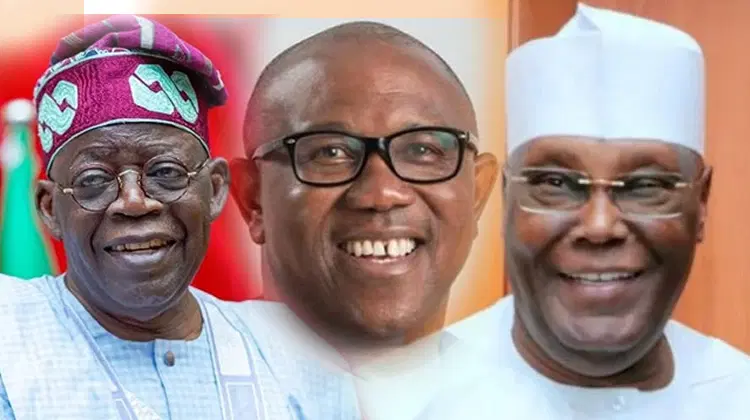
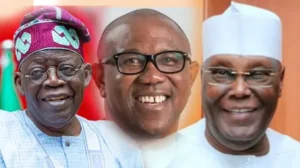
*INEC has disowned fabricated mock election results ranking Peter Obi, Bola Tinubu and Atiku Abubakar ahead of 2027.
Etim Ekpimah
The Independent National Electoral Commission (INEC) has disowned purported results of a mock presidential election published on a website, warning Nigerians against believing or circulating figures showing Peter Obi, President Bola Tinubu and Atiku Abubakar leading the contest.
The commission said the figures published on neis.ng, the website of the Nigeria Election Intelligence System (NEIS), were fabricated, misleading and had no connection with its electoral activities.
The website had claimed that Obi, the presidential candidate of the Nigeria Democratic Congress (NDC), was leading the purported exercise with 5,775,102 votes, representing 31.5 per cent.
Tinubu of the All Progressives Congress (APC) was placed second with 5,612,075 votes, or 30.6 per cent, while Abubakar of the African Democratic Congress (ADC) came third with 5,471,831 votes, representing 29.8 per cent.
However, INEC dismissed the figures, insisting that its mock accreditation and election exercise was strictly designed to test its technology, electoral processes and logistics ahead of the 2027 general elections.
In a statement signed by the Chief Press Secretary and Media Adviser to the INEC Chairman, Adedayo Oketola, the commission said neis.ng was neither affiliated with nor authorised to publish information on its behalf.
INEC explained that the mock exercise, conducted on Saturday, did not involve actual political parties or candidates, making the purported presidential rankings entirely baseless.
“The mock exercise did not feature real political parties or candidates. It used pseudo names generated solely for the dummy ballot papers, which Nigerians saw during the exercise,” the commission said.
A review of the website showed that its page, titled 2027 Public Mock Election Night Simulation, carried the inscription ‘Collation in progress’ and indicated that 51.2 per cent of polling units had reportedly submitted results.
The platform also claimed that Seyi Makinde of the Allied Peoples Movement (APM) occupied fourth position with 964,546 votes, representing 5.3 per cent, while Adewole Adebayo of the Social Democratic Party (SDP) came fifth with 100,734 votes, or 0.6 per cent.
Fourteen other candidates were also listed.
The website further displayed purported electoral statistics, including 48,034,303 registered voters, 18,806,044 accredited voters, 18,335,722 valid votes and 470,322 rejected ballots, putting voter turnout at 39.2 per cent.
Its zonal breakdown claimed that the APC was leading in the North-Central, the ADC in the North-East and North-West, and the NDC in the South-East.
But INEC maintained that the exercise was never intended to produce electoral winners or losers, warning that anyone presenting the figures as authentic results was deliberately misleading the public.
“Any claim that a candidate or party won, led or trailed in the mock exercise is therefore baseless, and any website or platform presenting such figures as mock election results is deceiving the public,” Oketola said.
The commission urged Nigerians, political parties, candidates and media organisations to disregard the figures and avoid sharing them, stressing that only information published through its official website, inecnigeria.org, and verified social media accounts should be treated as authentic.
INEC added that it was reviewing the matter and could take appropriate action against those responsible for circulating what it described as false election information.