Eno courts investors for Ibom Deep Seaport
Akwa Ibom State Governor, Pastor Umo Eno, has intensified efforts to attract investors to the Ibom Deep Seaport project, holding strategic meetings in Paris, France, aimed at accelerating implementation and positioning the state as a major trade and logistics hub in the Gulf of Guinea.
The governor, on June 5, 2026, met with executives of Africa Global Logistics (AGL) Group and members of the Ibom Deep Seaport Technical Committee to review the Technical Feasibility Report prepared by Worley Parsons, as part of moves to transition the project from planning to execution.
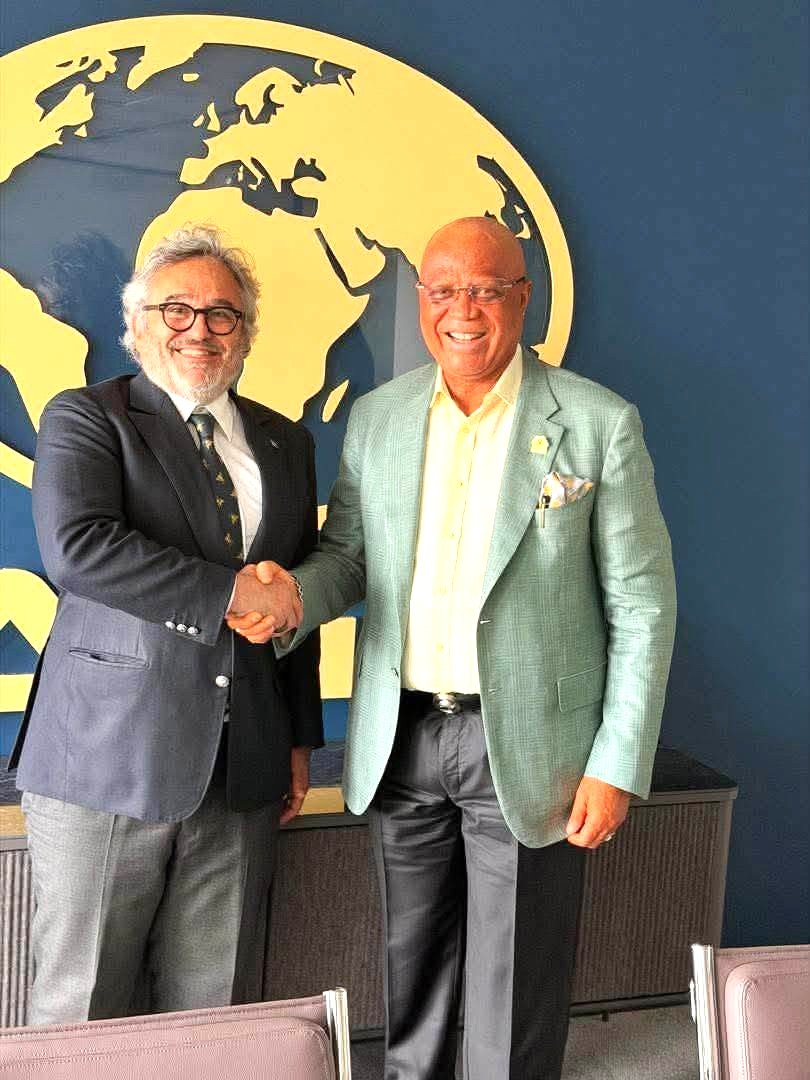
*Gov Eno with one of the investors for Ibom Deep Seaport
Etim Ekpimah
Akwa Ibom State Governor, Pastor Umo Eno, has intensified efforts to attract investors to the Ibom Deep Seaport project, holding strategic meetings in Paris, France, aimed at accelerating implementation and positioning the state as a major trade and logistics hub in the Gulf of Guinea.
The governor, on June 5, 2026, met with executives of Africa Global Logistics (AGL) Group and members of the Ibom Deep Seaport Technical Committee to review the Technical Feasibility Report prepared by Worley Parsons, as part of moves to transition the project from planning to execution.
The engagement comes amid rising pressure on Nigeria’s port infrastructure, following significant growth in cargo volumes across the country’s maritime sector.
Nigeria’s maritime sector recorded substantial expansion in 2025, with cargo throughput increasing by 24.8 per cent from 103.6 million metric tonnes to 129.3 million metric tonnes. Container traffic also rose by 25.7 per cent to over 2.1 million twenty-foot equivalent units (TEUs), while exports accounted for 39 per cent of total cargo volume.
While the figures reflect sustained growth in trade activities, they also highlight mounting pressure on existing port facilities and the urgent need for expanded logistics infrastructure.
During the Paris meetings, discussions centred on project sequencing, investment mobilisation strategies, financing structures, and long-term operational sustainability.
According to the Commissioner for Information, Dr Aniekan Umanah, Eno emphasised the importance of clear timelines, measurable milestones, and execution-focused planning.
He said the administration remains committed to ensuring infrastructure projects translate into measurable economic benefits.
“The administration’s priority is to ensure infrastructure projects translate into measurable economic benefits,” Umanah said.
The Ibom Deep Seaport is being designed as more than a maritime facility. Government officials said it is intended to function as an integrated economic ecosystem capable of attracting manufacturing investments, logistics operators, export processing activities, warehousing infrastructure, and financial services.
The project is expected to complement other major state assets, including the Liberty Free Trade Zone, the proposed Ibom Industrial City, Victor Attah International Airport, and ongoing investments across agriculture, manufacturing, tourism, energy, and the digital economy.
Together, these assets are expected to create an integrated industrial and logistics corridor aimed at strengthening exports and improving supply chain efficiency.
Akwa Ibom’s location along the Gulf of Guinea places it within strategic proximity to major regional shipping routes connecting West and Central African markets.
A fully operational deep seaport could strengthen trade connections with neighbouring economies such as Cameroon, Equatorial Guinea, and Gabon while reducing pressure on Nigeria’s congested port infrastructure.
For businesses, the project could shorten shipping timelines, lower inland logistics costs, and expand market access. For the government, it presents opportunities for increased trade revenues and foreign exchange earnings.
Since assuming office, Governor Eno has pursued an economic strategy anchored on infrastructure-led industrialisation, private sector participation, and diversification, with an emphasis on creating interconnected assets capable of driving sustained economic activity.
Analysts believe the seaport could also generate regional benefits beyond Akwa Ibom.
Manufacturers and exporters across Rivers, Delta, Bayelsa, Cross River, Edo, and South-East states could gain improved access to maritime logistics and less congested shipping channels.
Residents in Oron Federal Constituency, where expectations surrounding the project remain high, have also expressed optimism.
A petroleum marketer, Mr Nyong Effiong Nyong, said: “The project could stimulate investment and commercial expansion across coastal communities.”
Similarly, trader Mrs Angela Etim said: “The project could restore economic vibrancy to the Oron area while creating opportunities for young entrepreneurs and small businesses.”
Despite the optimism, stakeholders acknowledge that execution remains the defining factor.
Financing arrangements, regulatory coordination, supporting infrastructure, and sustained investor confidence are expected to determine how quickly the project moves from concept to reality.
Eno was accompanied during the Paris engagement by the Chairman of the Technical Committee and former Director-General of the Nigerian Maritime Administration and Safety Agency, Mrs Mfon Usoro; Secretary to the State Government, Prince Enobong Uwah; Commissioner for Science and Digital Economy, Dr Frank Ekpenyong; Managing Director of Hensek Integrated Services, Engr Uwem Okoko, FNSE; and other officials.
Officials said the objective of the trip was to accelerate progress towards making the project bankable and investment-ready.
As competition for logistics infrastructure intensifies across West and Central Africa, Akwa Ibom’s push to develop the Ibom Deep Seaport signals an ambitious attempt to secure a strategic position within the evolving regional trade architecture.
If successfully delivered, the project could emerge as a major maritime gateway, reshape industrial activities across southern Nigeria, and strengthen the country’s competitiveness within the Gulf of Guinea trade corridor.