Bayelsa community rejects oil spill sabotage investigation findings
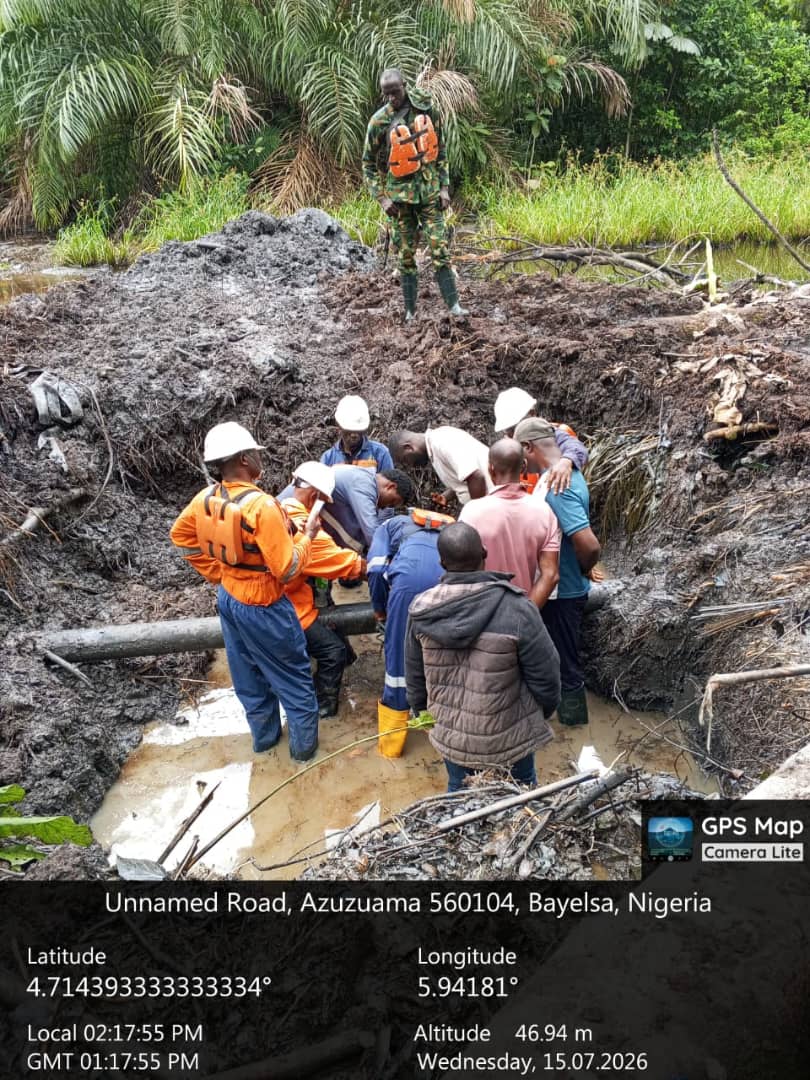
A dispute has erupted over the findings of a Joint Investigation Visit (JIV) into an oil spill at Azuzuama community in Southern Ijaw Local Government Area of Bayelsa State, with residents rejecting the conclusion that sabotage caused the incident.
The spill occurred on 25 June along Oando’s six-inch Azuzuama–Tebidaba flowline.
The JIV, a statutory investigation that determines the cause, estimated spill volume and extent of environmental impact following oil spill incidents, forms the basis for remediation and compensation. It comprises representatives of the operating oil company, regulatory agencies, the host community and the state Ministry of Environment.
Nathan Tamarapreye, Yenagoa
A dispute has erupted over the findings of a Joint Investigation Visit (JIV) into an oil spill at Azuzuama community in Southern Ijaw Local Government Area of Bayelsa State, with residents rejecting the conclusion that sabotage caused the incident.
The spill occurred on 25 June along Oando’s six-inch Azuzuama–Tebidaba flowline.
The JIV, a statutory investigation that determines the cause, estimated spill volume and extent of environmental impact following oil spill incidents, forms the basis for remediation and compensation. It comprises representatives of the operating oil company, regulatory agencies, the host community and the state Ministry of Environment.
However, the investigation ended without a consensus after community representatives rejected the finding that the spill resulted from “induced corrosion” caused by deliberate human interference.
According to a field report by the Environmental Conservation Agriculture and Rural Development (ECARD), the conclusion that the June 2026 spill was caused by induced corrosion drew strong opposition from the host community, rendering the investigation inconclusive.
The Director of Petroleum and Pollution at the Bayelsa State Ministry of Environment, Engr. Reuben Enai, who participated in the investigation, said visual examination of the damaged pipeline revealed burn marks on its protective coating, suggesting acid had been deliberately applied to weaken the pipe.
He said the damage occurred at the 12 o’clock, or uppermost, section of the pipeline, arguing that natural corrosion could not have caused deterioration in that position.
Community leaders, however, maintained that the spill resulted from equipment failure and long-term corrosion, rejecting Oando’s conclusion that sabotage was responsible.
The disagreement persisted despite several inspection visits involving Oando, the National Oil Spill Detection and Response Agency (NOSDRA), the Bayelsa State Ministry of Environment and representatives of the host community.
ECARD said a further inspection conducted on 15 July also failed to produce an agreed outcome, leaving the official cause of the spill unresolved.
Chairman of the Azuzuama Community Development Committee, Angasei Perediseghebofa, said visible rust on the exposed section of the pipeline pointed to corrosion rather than sabotage.
He also alleged that testing equipment introduced by Oando malfunctioned during the investigation, preventing investigators from reaching a credible conclusion.
The committee’s Vice Chairman, Uyabara Boneghen, questioned the reliability of the testing devices after they reportedly produced identical readings at different locations.
Boneghen further drew attention to a second leak beneath a platform in the river, alleging that bubbling gas at the site posed additional environmental risks that had yet to be investigated.
The latest spill has revived memories of the 9 July 2015 pipeline explosion in the same Azuzuama corridor.
Fourteen people, including officials of NOSDRA and the Bayelsa State Ministry of Environment, were killed during a Joint Investigation Visit and pipeline repair operation when an explosion engulfed the site.
The incident remains one of the deadliest pipeline-related disasters in the Niger Delta and continues to fuel community mistrust of oil spill investigations.
ECARD urged Oando to immediately contain the spill, clean up contaminated areas and repair the reported underwater leak to prevent further environmental damage.
The organisation also called for an independent investigation into the underwater leak, warning that continued hydrocarbon discharge could further degrade the community’s aquatic ecosystem.