Army chief pledges N25m for retired officers’ medical care
Chief of Army Staff, Lt Gen Waidi Shaibu, has pledged N25 million to support the medical needs of retired military officers through an emergency health fund.
Shaibu made the commitment when the Executive Committee of the Course 39 Nigerian Defence Academy United Welfare Association, led by its president, Air Vice Marshal Ibikunle Daramola (retd.), visited Army Headquarters in Abuja on Thursday.
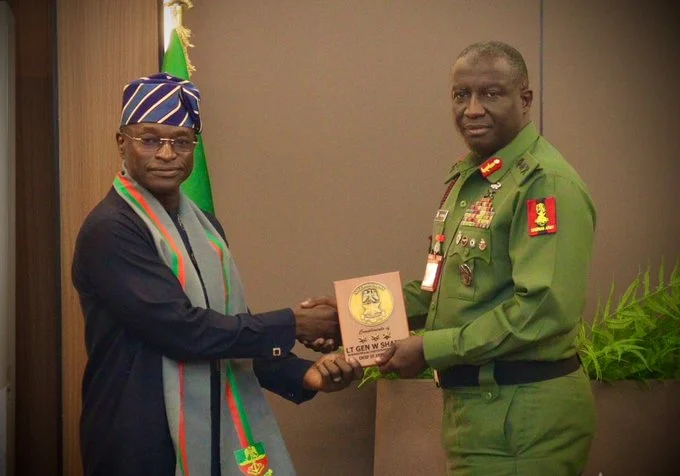
*Shaibu and Daramola
Etim Ekpimah
Chief of Army Staff, Lt Gen Waidi Shaibu, has pledged N25 million to support the medical needs of retired military officers through an emergency health fund.
Shaibu made the commitment when the Executive Committee of the Course 39 Nigerian Defence Academy United Welfare Association, led by its president, Air Vice Marshal Ibikunle Daramola (retd.), visited Army Headquarters in Abuja on Thursday.
The fund is intended to provide emergency medical support for members of the association, reinforcing the Army leadership’s stated commitment to the welfare of personnel beyond active service.
In a post on the Nigerian Army’s X handle, Shaibu said caring for those who had served the country remained an enduring responsibility.
“Underscoring the Army’s commitment to the welfare of its personnel beyond active service, we have pledged ₦25 million to the association’s Emergency Health Fund to support the medical needs of its members,” he said.
Shaibu also described continued engagement with retired officers and veterans as important to the Army’s institutional development, citing their operational experience, professional knowledge and leadership expertise.
He said such engagement could strengthen institutional memory, mentorship and continuity while providing useful perspectives on contemporary security challenges.
The Army chief also outlined reforms aimed at expanding the service’s operational capacity and adapting it to changing security demands.
He said the Nigerian Army had expanded to 12 divisions and integrated 28,000 recruits through regional training depots in Zaria, Osogbo and Amasiri Edda.
According to him, the Army is also implementing a revised training curriculum with greater emphasis on marksmanship, physical fitness and fieldcraft to prepare troops for increasingly complex operational environments.
Shaibu said the service was further transitioning towards multi-domain operations through the integration of space, cyber and non-kinetic capabilities.
He added that the Army was developing its aviation and unmanned aerial systems to improve situational awareness, mobility and responsiveness to emerging threats.
On post-service welfare, the COAS highlighted the Senior Executive Transition Programme, which prepares retiring senior officers and their spouses for life after active service.
Daramola, while congratulating Shaibu on his appointment as Chief of Army Staff and his promotion to lieutenant general, commended his efforts to strengthen the Army’s force structure and operational capabilities.
He also thanked the Army leadership for its support to the association, particularly in health insurance, emergency assistance and capacity-building programmes.
Daramola said members of Course 39 remained available to contribute their operational, technical and leadership experience through mentorship, advisory support and specialised expertise.