Ebola crisis deepens as UN seeks $1.1bn
The Ebola outbreak in the Democratic Republic of the Congo has killed about 2,700 people, with the United Nations warning that the response could deteriorate further without urgent international funding.
UN Secretary-General António Guterres said the humanitarian response was only 48 per cent funded and warned that existing resources could be exhausted within weeks.
The Ebola outbreak in the Democratic Republic of the Congo has killed about 2,700 people, with the United Nations warning that the response could deteriorate further without urgent international funding.
UN Secretary-General António Guterres said the humanitarian response was only 48 per cent funded and warned that existing resources could be exhausted within weeks.
“The challenge is immense,” Guterres told journalists at UN Headquarters in New York, appealing for an additional $1.1bn to sustain and expand containment operations.
He warned that vital operations could run out of funding at a critical point in the response, when health authorities need to intensify efforts to contain transmission and protect vulnerable communities.
“We know how to contain Ebola, how to interrupt transmission and how to save lives,” Guterres said, while warning against what he described as the “virus of indifference”.
The World Health Organisation said response measures had slowed transmission but had not yet reversed the overall trend.
Containment efforts have been complicated by insecurity, population displacement and weak health systems in parts of the country, particularly in areas affected by years of conflict.
More than 12 million people in the affected areas require humanitarian assistance and protection, according to the WHO.
In Ituri Province alone, about one million people have been displaced, making disease surveillance, contact tracing, treatment and other preventive measures more difficult.
The security situation has also placed health workers and emergency responders at risk. More than 40 healthcare workers have reportedly been killed, while treatment centres and ambulances have come under attack during the response.
The United Nations said the insecurity had effectively forced humanitarian workers to confront two crises simultaneously: the Ebola outbreak and the violence restricting access to affected communities.
Despite the challenges, humanitarian agencies have expanded their operations.
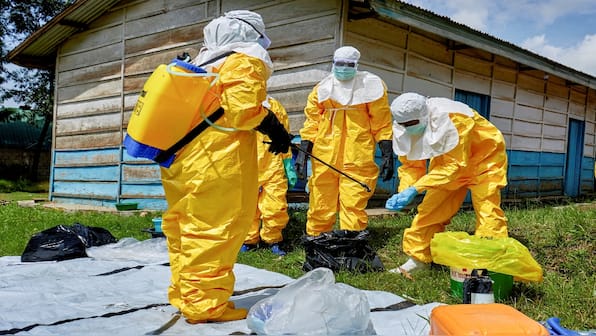
The UN Office for the Coordination of Humanitarian Affairs said 35 additional safe and dignified burial teams had been deployed, alongside 286 community-based teams involving more than 2,500 volunteers and civil protection personnel.
The WHO has also deployed more than 260 experts and delivered more than 330 tonnes of medical and logistical supplies to support treatment, surveillance and containment operations.
The World Food Programme is supporting frontline operations and medical evacuations through the UN Humanitarian Air Service, while the International Organisation for Migration has screened more than one million people across the region.
The IOM has also launched a preparedness plan covering 11 countries amid concerns over the possible cross-border spread of the virus, particularly into neighbouring Burundi.
Although Burundi has recorded no confirmed cases, the WHO said the country was strengthening laboratory capacity, response procedures and public awareness because of its proximity to affected areas of the DRC.
The development comes as Uganda has been declared free of its Bundibugyo Ebola outbreak after recording no new confirmed case for 42 consecutive days.
Uganda recorded 20 infections and two deaths during the outbreak.
The 42-day period is the internationally recognised benchmark for declaring an Ebola outbreak over, representing twice the upper limit of the virus’s incubation period.
The contrasting developments in Uganda and the DRC highlight the importance of sustained surveillance, rapid response and adequate funding in containing Ebola outbreaks.
Guterres said the international community must act quickly to prevent the situation in the DRC from worsening.
The UN’s appeal is aimed at ensuring that treatment, surveillance, vaccination-related preparedness, community engagement, safe burials and other essential response activities can continue while authorities work to bring transmission under control.
NAN