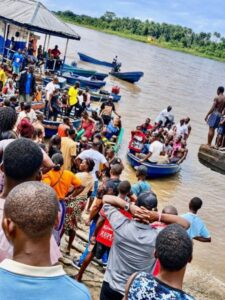
Bayelsa boat tragedy: Coast Guard committee demands safety reforms
The Provisional Committee for the Establishment of the Nigerian Coast Guard (PC-NCG) has called for urgent reforms in inland waterway safety enforcement following a boat accident in Bayelsa State that claimed four lives.
The committee said the tragedy had exposed persistent safety challenges, including unseaworthy vessels, passenger overloading, poor enforcement of regulations, inadequate use of life jackets and weak emergency response systems.
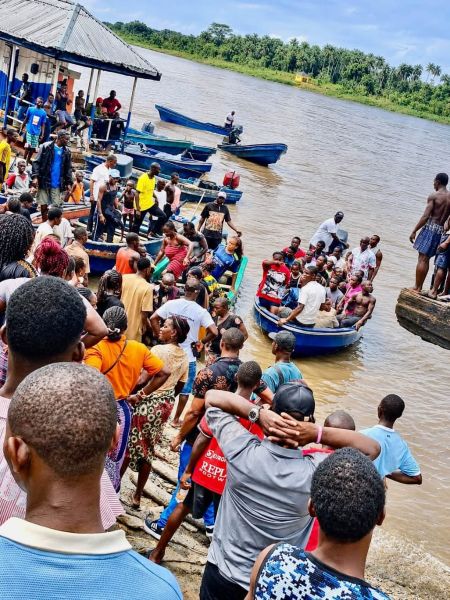
*Boat mishap
Nathan Tamarapreye, Yenagoa
The Provisional Committee for the Establishment of the Nigerian Coast Guard (PC-NCG) has called for urgent reforms in inland waterway safety enforcement following a boat accident in Bayelsa State that claimed four lives.
The committee said the tragedy had exposed persistent safety challenges, including unseaworthy vessels, passenger overloading, poor enforcement of regulations, inadequate use of life jackets and weak emergency response systems.
This was contained in a statement issued on Saturday by the Director of Communications and Public Affairs, Dr Piriye Kiyaramo, on behalf of the Chief Executive and Accounting Officer, Capt Noah Omonu Ichaba.
The committee expressed condolences to the bereaved families, affected communities and the Bayelsa State Government, praying for the repose of the souls of the deceased, comfort for their families and speedy recovery for those injured.
According to the statement, the accident occurred at about 11 am on Friday at the river junction between Oweikorogha and Otuan communities along the River Nun in Southern Ijaw Local Government Area.
The boat was reportedly travelling from Ayama community to Ukubie for a burial ceremony when it capsized.
Police authorities said four people, including two children, died, while 24 others were rescued.
Although the police attributed the accident to a mechanical fault, some survivors reportedly raised concerns about overcrowding before the boat capsized.
“Every life lost on our waterways is a painful reminder that maritime safety must never be treated as an afterthought,” the committee said.
It commended the police, marine personnel, local divers, community responders, medical personnel and other agencies involved in the rescue and recovery operations.
Rising fatalities on inland waterways
Describing the Bayelsa accident as part of a recurring national safety crisis, the committee cited media reviews indicating a 63 per cent increase in fatalities from major boat accidents in the first half of 2026 compared with the corresponding period in 2025.
It also referenced another review that recorded at least 70 boat accidents nationwide in 2026.
According to the statement, at least 117 people died in three separate boat accidents in Yobe, Jigawa and Sokoto states between January and August 2026.
The committee further disclosed that at least 972 people lost their lives in reported boat accidents between 2022 and 2025.
It acknowledged, however, that figures released by the police, National Emergency Management Agency (NEMA), National Inland Waterways Authority (NIWA) and media organisations sometimes differ because of unmanifested passengers and ongoing recovery operations.
It maintained that discrepancies in casualty figures should not detract from the urgent need to address recurring safety failures on the country’s waterways.
Committee demands investigation, enforcement
The PC-NCG urged relevant authorities to conduct a thorough investigation into the Bayelsa accident, particularly the reported mechanical failure and allegations of passenger overloading.
It said anyone found culpable of negligence or violating safety regulations should face appropriate sanctions under the law.
The committee stressed that safety warnings alone would not prevent recurring accidents without effective enforcement, regular vessel inspections and accountability by boat operators.
It also called for improved access to life jackets, coordinated emergency response systems and practical measures to protect passengers travelling on inland waterways.
Coast Guard proposal gains urgency
The committee said the tragedy had reinforced the need for a coherent and adequately empowered national framework for civil maritime governance and law enforcement.
It argued that existing maritime responsibilities, personnel and institutional activities required better coordination, integration and accountability to improve passenger safety and protect the marine environment.
According to the statement, these considerations informed the proposal to establish the Nigerian Coast Guard and the ongoing legislative consideration of Senate Bill 575.
The committee said the proposed legislation should not be viewed merely as an attempt to create another government institution but as an opportunity to strengthen maritime safety, security, environmental protection, emergency response and institutional coordination.
It urged stakeholders to approach the legislative process with a focus on public safety and preventing avoidable loss of lives.
“Every passenger who boards a vessel deserves to return alive. Every child travelling on our waterways deserves protection. Every family deserves the assurance that water transportation is not a gamble with human life,” the committee said.
It warned against allowing the Bayelsa accident to become another casualty statistic without meaningful institutional and operational reforms.
“The loss of these lives must not become another news headline that fades with time, or another tragedy followed by warnings that are never translated into lasting action.
“May the lives lost in Bayelsa not be lost in vain,” it added.
The committee reaffirmed its advocacy for a maritime development framework anchored on the principles: “No Blue Economy Without Blue Security, Blue Justice, Blue Knowledge and Blue Reward.”