Reps summon NAFDAC, police over herbal drug deaths
The House of Representatives has resolved to summon the heads of the National Agency for Food and Drug Administration and Control (NAFDAC), the Department of State Services (DSS) and the Nigeria Police Force over the alleged circulation of a poisonous herbal medicine that reportedly killed four people in Benue State.
The resolution followed the adoption of a motion of urgent public importance moved on Wednesday by David Agada, representing Obi/Oju Federal Constituency of Benue State.
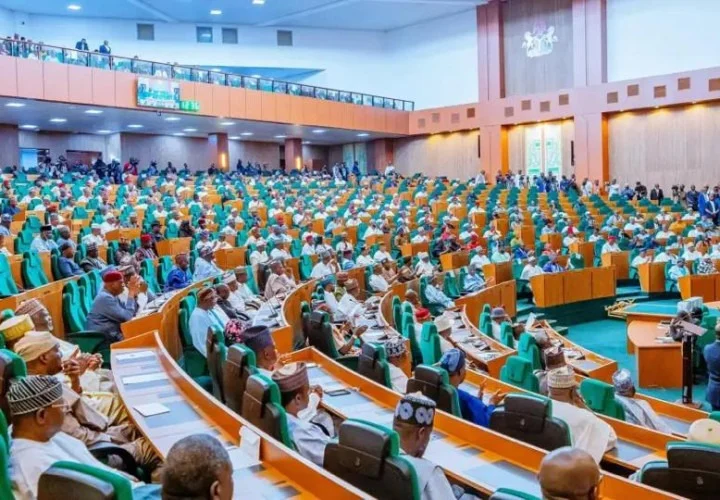
*House of Reps Green Chamber
Nkereuwem Effiong
The House of Representatives has resolved to summon the heads of the National Agency for Food and Drug Administration and Control (NAFDAC), the Department of State Services (DSS) and the Nigeria Police Force over the alleged circulation of a poisonous herbal medicine that reportedly killed four people in Benue State.
The resolution followed the adoption of a motion of urgent public importance moved on Wednesday by David Agada, representing Obi/Oju Federal Constituency of Benue State.
Presenting the motion, Agada said three individuals allegedly introduced and distributed the herbal product in his constituency on October 31, 2026, claiming it could cure typhoid fever, waist pain and other ailments.
He said several residents who bought and consumed the product developed severe symptoms within hours and were rushed to hospitals for emergency treatment.
According to the lawmaker, four people died following the incident. They were identified as Awugo Joseph Oyije, who died on November 2; James Ogah Onma, who died on November 4 after being referred for further treatment; Ode Friday Ogah, who died on November 5; and Agi Edugbeke, who died on November 11.
Agada disclosed that 11 other residents were affected and were receiving medical attention, with two referred to hospitals in Makurdi.
The affected persons were identified as Otumala Ochele, Binta Sule, Onu Oboh, Adoga Onu, Upa James, Igbo Pius, Ochele Genesis, Otumala Amos, Uwa Baku, Ate Vivian Okpune and Roman Ehile.
He warned that other residents might have consumed the suspected medicine without being identified, raising fears of additional casualties.
The lawmaker said the product’s composition, source, manufacturing conditions, registration status, dosage and possible adverse effects had yet to be established.
He urged relevant authorities to investigate the deaths, determine the product’s safety and prevent further exposure, while ensuring that anyone found culpable was brought to justice.
Contributing to the debate, House Leader Julius Ihonvbere described the circulation of counterfeit drugs and adulterated drinks as a nationwide public health threat requiring stronger regulatory enforcement.
He questioned NAFDAC’s capacity to tackle the problem, citing its workforce of about 2,000 personnel, which he said was inadequate to monitor the country’s extensive drug distribution network.
Ihonvbere argued that the agency needed at least 10,000 personnel to effectively discharge its responsibilities.
He warned that more Nigerians could die if the proliferation of fake medicines and adulterated drinks was not urgently addressed.
The House Leader also advocated tougher penalties, including life imprisonment or the death penalty, for those involved in manufacturing and distributing counterfeit products.
Similarly, Ali Shettima, a lawmaker from Yobe State, urged the House to address the nationwide threat rather than restrict its response to the Benue incident.
He called on NAFDAC to strengthen its regulation of herbal medicine producers and supported legislation prescribing stiffer punishments for offenders.
However, another Yobe lawmaker, Fatima Talba, attributed the growing patronage of unregulated herbal medicines partly to limited access to affordable and reliable healthcare.
She argued that many Nigerians resorted to such products because they lacked accessible alternatives, adding that counterfeit medicines were also a concern within the formal healthcare system.
Peter Uzoekwe, representing Anambra State, proposed holding market leaders accountable for the sale and distribution of counterfeit medicines.
He suggested that market executives should face sanctions, including removal from office, where such products were manufactured or sold under their watch. Uzoekwe argued that making market leaders accountable would encourage them to help identify and stop dealers involved in the illicit trade.