Unyenge bridge collapse: 15 days on, work still stalled
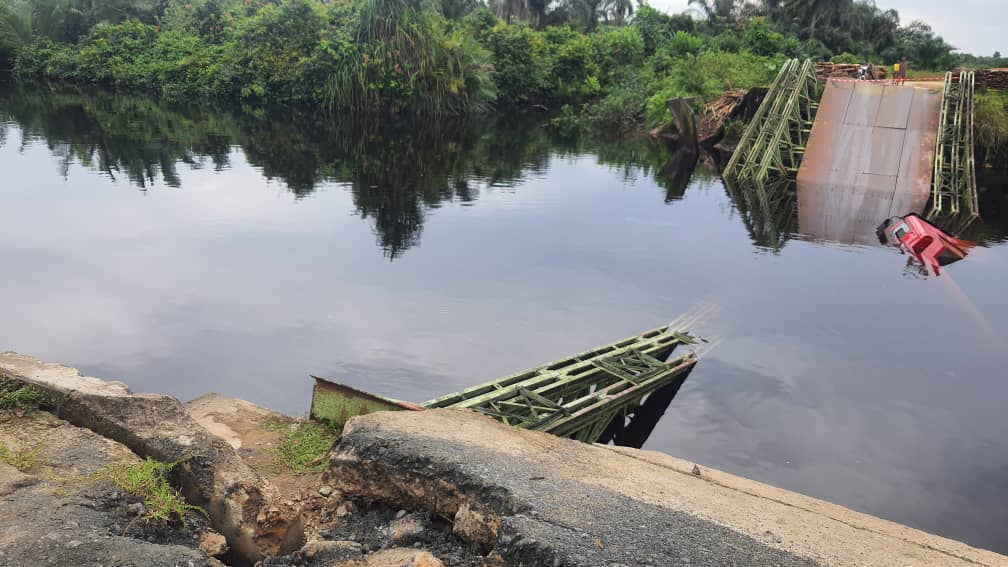
*Collapsed unyenge bridge
When the bridge linking the two sides of Unyenge—Uko Edei Inyang (Edei Apak) and the main village—collapsed on Tuesday, October 14, 2025, reportedly due to an overloaded truck weighing 50 tonnes or more, the contractor announced that Governor Umo Eno had directed him to commence remedial work to restore movement across the bridge.
Findings revealed that the bridge was originally built by Shell Petroleum Development Company and later reinforced by Universal Energy after acquiring Shell’s stake and operations in the area. However, the bridge was not designed for heavy loads; it was intended only for the transport of light work materials between both sides.
It was later discovered that goods weighing between 75 and 120 tonnes were routinely transported across the bridge. The contractors reportedly ignored the bridge’s load capacity, repeatedly moving such heavy cargo. This constant overloading was said to have weakened the structure, leading to its eventual collapse, and the truck carrying construction materials fell into the water.
On Wednesday, October 15, 2025, the Special Adviser to Governor Umo Eno on Cooperatives and Rural Development, Alice Ekpenyong, assured the people that the governor had mandated the contractor to begin remedial work on the bridge within two days.
According to her, the governor contacted Mr Aiman Saimua, Chief Executive Officer of Amitec Construction and Development Limited, instructing him to visit the site urgently and assess possible remedial measures.
“When we came for inspection earlier, the governor mentioned plans to expand this road into a dual carriageway to support the Ibom Deep Seaport project,” Ekpenyong said.
She added, “The road has already been captured in the 2026 budget, pending design approval. Once approved, construction will commence in earnest.”
She noted that the governor was displeased by the collapse, prompting his directive for an on-site evaluation.
“He called the contractor to assess the situation and outline immediate solutions. What we need now is cooperation from the community. Our youths have always been peaceful,” she enthused.
Ekpenyong noted that the intervention would ensure temporary access for residents and businesses until the road’s full reconstruction begins.
Saimua explained that the temporary bridge would be built using steel casings and laterite, though boat movement across the river would be restricted during the works.
“This is going to be a temporary bridge. This is not even going to be a bridge. What is going to be, we will put in giant steel castings for the water to pass.
“Once the bridge is built, we will now excavate that and move it. It will be just like the dam coffer we did on a few contracts before,” he said.
Concerning the water level, Saimua stated that they had measured it when they were running tests for the bridge’s foundation, adding that the depth of the water is about 6 metres. He said that they did some deep soil investigations, too.
Saimua revealed that they did not know where the new bridge was going to be, adding, “That is that we don’t know where the alignment is going to be; we are waiting for the consultants.”
The contractor then explained that compensation would be paid to those whose property is involved before work began in earnest the following day.
Indigenes and residents of Unyenge have expressed growing concern over the bridge’s condition, as oil workers and other commuters are now ferried across the water daily in canoes.
An indigene, Edet Akpanim, pleaded with Eno to quicken the action so that they could resume their business on the other side of the bridge.
He said, “Since the bridge collapsed, I’ve been unable to do anything. Transporting firewood across the river is extremely costly. I can’t continue my business—that’s why we’re desperately calling for government intervention.”
Efforts to reach Saimua for comment were unsuccessful, as he neither answered calls to his phone nor responded to text messages.
Likewise, the Commissioner for Works, Prof. Eno Ibanga, did not take calls placed to his line. He only replied with a brief message asking that a text be sent, but he had yet to respond to it as of press time.